
Institutional knowledge is one of the most valuable assets in the construction industry, and we treat it like an afterthought. The experience gained over the course of a career, a project, or even a single bad day in the field represents information that cannot be replicated in a classroom or found in a training manual. It is earned the hard way, and when it walks out the door it takes a piece of the organization with it whether anyone notices or not.
The construction industry has a knowledge problem, and it is getting worse.
The Lessons Learned Meeting That Changes Nothing
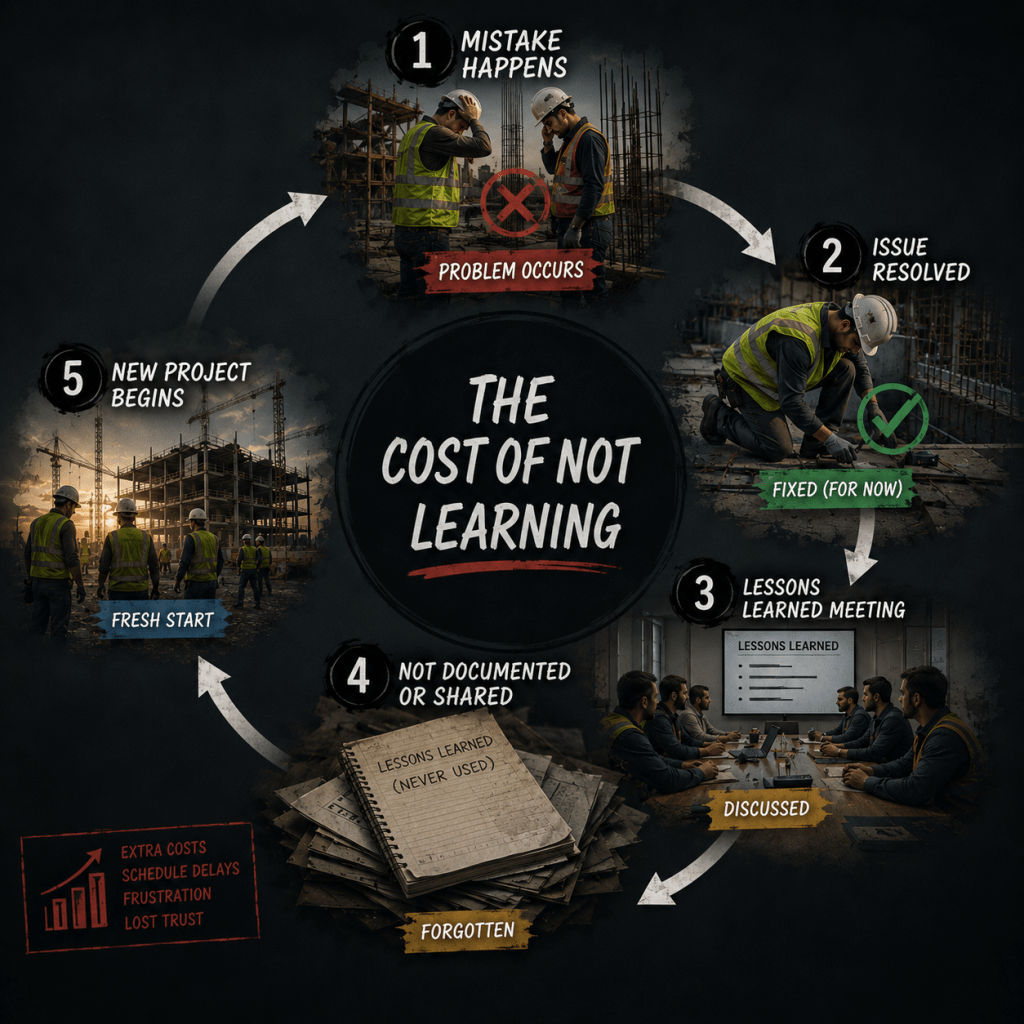
Most companies understand the concept of lessons learned, at least in theory. A project wraps up, the team gets together, someone takes notes, and the highlights get discussed over a conference room table. It feels productive in the moment, and technically the box gets checked. The problem is that those notes end up in a shared drive folder that nobody opens, the nuance that actually caused the issues never makes it into the conversation, and the next project team starts from scratch without any awareness that the same pitfalls are waiting for them.
The lessons learned meeting is only as valuable as what you do with the information that comes out of it. When the output is a summary document that collects dust, the exercise becomes another example of doing something just to say it was done. The real cost of that approach shows up six months into the next project when the same sequencing issue, the same subcontractor coordination failure, or the same design oversight creates the same delay that it created the last time around. Nobody connected the dots because nobody ever made the information accessible or actionable in the first place.
There is also a timing problem worth addressing. Conducting a lessons learned review only at project closeout means that the most critical details have already faded. The specific conversation that led to a bad decision, the early warning sign that got dismissed, the moment where a different choice would have changed the outcome entirely, those details live in the memory of the people who were there and they get hazier with every passing week. Waiting until the end to capture them means accepting that a significant portion of what actually happened will never make it into the record.
The Retiring Craftsman Problem
There is a generational shift happening in the construction industry that is accelerating this problem in a way that should concern every organization that depends on experienced talent. The craftsmen and superintendents who built their careers over thirty or forty years are retiring at a pace the industry is not prepared for, and the intuition and field knowledge they carry with them is not being captured before they go. It is simply lost.
No training program can fully account for this. Trade schools and construction management programs teach the fundamentals and give someone the framework to understand how things are supposed to work. That foundation is important and necessary, but it has a ceiling. The real education happens in the field when you are standing in front of a problem that no textbook ever covered and you have to figure it out. The value of having someone nearby who has seen that problem before, who knows why the standard approach won’t work in this particular situation, and who can walk you through a better solution is almost impossible to overstate.
When that person retires and that knowledge isn’t documented, the next generation is left to learn the same lessons the hard way. They will make the same costly mistakes, run into the same unforeseen conditions, and ask the same questions that were already answered a decade ago by someone who no longer works there. The company absorbs that cost over and over again because nobody ever made it a priority to preserve what they had.
Turning Experience Into a Living Resource
The solution isn’t a better end-of-project meeting. It is a commitment to harvesting knowledge continuously and converting it into something the entire organization can actually use. That means capturing lessons as they happen rather than waiting until the project is over and the details are already slipping away. It means going beyond the highlights and documenting the nuance, the context, the specific conditions that made a situation difficult and the reasoning behind how it was resolved.
That information should live somewhere accessible and searchable, not buried in a folder that requires three people to know where to look. It should be referenced during pre-construction planning, incorporated into onboarding for new team members, and revisited when similar project types or challenges arise. When it is built into the workflow rather than treated as a closeout formality, it becomes a genuine competitive advantage.
The companies that figure this out are the ones that stop repeating expensive mistakes and start compounding the value of every project they complete. The ones that don’t will keep starting from zero, wondering why the same problems keep showing up, and losing ground every time an experienced employee walks out the door. If your success hinges on one person being on site to complete a task because they’re the only person that knows how, then you’re failing yourself and your employees.
Experience is only an asset if the organization benefits from it. The goal shouldn’t be to simply have knowledgeable people. The goal should be to build an organization that retains that knowledge long after those people are gone. The firms that figure out how to do this successfully are going to be the ones that excel throughout this age of exponential change.


Leave a Reply