
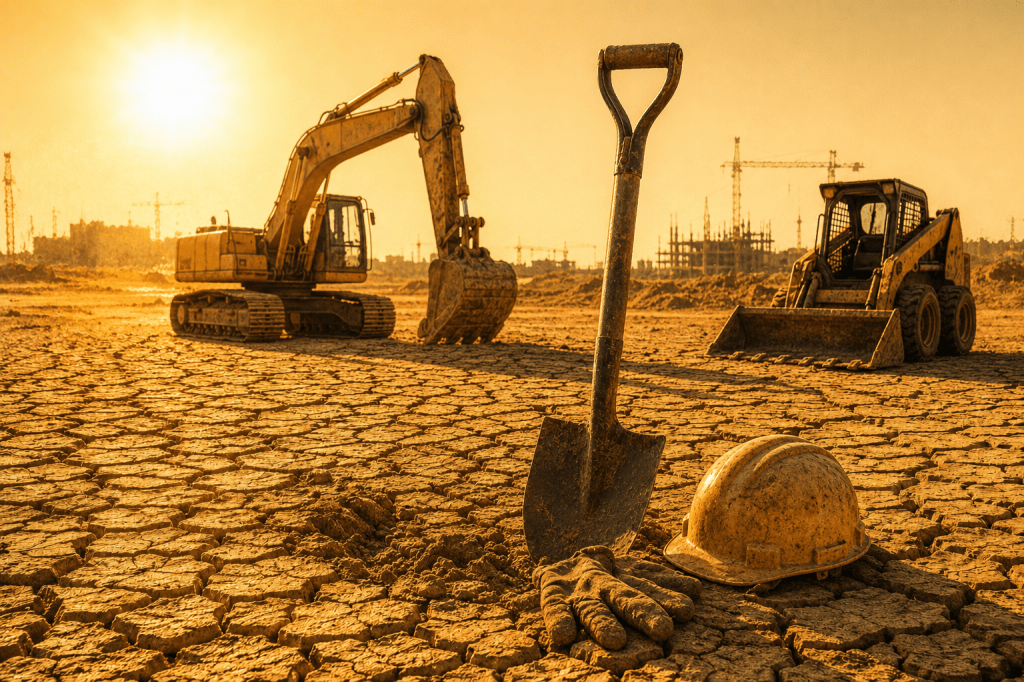
On our project a large CIP Retaining Wall is currently being installed and it’s got me thinking about the weather. Every time I walk out of the office trailer to go check progress it’s a gut punch. You can’t escape it. 95-degree averages with heat indexes of 105+. The guys working out in this have limited shade and can’t avoid working in the sun to get this wall installed. Imagine handling hot rebar in a trench all day when it feels like 100 degrees. These guys out there in the trench are having to drink water just to replace what they’ve sweat out and they’re having trouble keeping up.
The problem is that nowhere is safe. A recent 10-day forecast showed highs around the US all exceeding 90-degrees on average not including heat index. Nashville, TN at 99-degrees, Orlando, FL at 94-degrees, Houston, TX at 96-degrees, New York City, NY at 101-degrees, Chicago, IL at 95-degrees, and Denver, CO at 96-degrees. This isn’t just a U.S. problem though. Montreal, Canada at 90-degrees, London, England at 92-degrees, Paris, France at 97-degrees, New Delhi, India at 101-degrees, Beijing, China at 96-degrees, Jakarta, Indonesia at 92-degrees. Nowhere in the world is immune to rising temperatures and extreme heat waves.
OSHA’s proposed heat safety requirements have an initial heat trigger of 80-Degrees and a High Heat Trigger of 90-Degrees. These heat thresholds serve as the indicator for when an employer is required to take certain actionable steps to prevent heat related illness and injury (OSHA, 2024). However, we’re in a world now where what’s called high-heat is just the average day. A whole new category for 100-110+ degree days needs to be included for this new rule to not seem obsolete on day one of implemented.
The New Reality
The unfortunate truth is that these extreme temperatures aren’t going away. The past 11 years have been the hottest years on record with 2023-2025 holding 1st, 2nd and 3rd place. 2026 is also on track to become the hottest year in recorded history (WMO, 2026). It’s impossible to argue that the world isn’t getting hotter. Walk outside and you can feel it.
Heat doesn’t just make a workday uncomfortable though. It changes what the human body can safely do, and it changes how long a person can do it. Fine motor tasks like tying rebar or making precise cuts become harder as the body works overtime trying to cool itself down. Reaction time slows and judgment becomes less reliable. The risk of heat exhaustion and heat stroke rises with every additional degree, and those are not minor injuries. They can be fatal if they are not caught early.
On a practical level, this means crews need more water, more shade, and more rest than they needed a decade ago. They need it on a schedule that matches the actual conditions rather than a generic break schedule written for a milder climate or as a catch-all to check off a line item for safety. A crew laying rebar for a footing at midday during a 105-degree heat index is operating in a fundamentally different environment than the same crew working the same task on a 78-degree day. Treating those two scenarios the same way is how people get hurt. It also creates an unrealistic expectation of production capability a field team can’t reasonably produce under these conditions.
A Strained Workforce
Extreme heat is becoming one of the defining operational challenges facing the construction industry. There is a shortage of skilled trade labor currently in the nation to deliver the existing project log we currently have. The roles that will be the hardest to fill will be the ones with the highest physical and mental toll. Who would want to take on a job where you spend your entire day being miserable and exhausted?
Construction has always had a reputation for hard manual labor and rough field conditions. Performing manual labor in extreme heat turns this from a stereotype into a harsh reality. The amount of people willing to perform this work will diminish and it will severely impact production schedules. Labor costs for these trade divisions are going to have to rise to attract more talent which will further inflate project costs.
Changes to Project Delivery
A major issue is that our entire industry relies on assumptions of ways of working that no longer exist. Extreme temperatures are going to force us to rethink how we deliver projects. Timelines will have to be extended to allow for rest breaks and decreases in productivity. Sequencing will change and site logistics will adjust to match. Material selections, installation methods, and architectural details all have to be re-evaluated to ensure that they’re still best practice.
A practical example of this is the USDA Plant Hardiness Zone Map. The 2023 update from the 2012 model saw a 2.5-degree change in warmer temperatures. This caused the habitable planting zones for half of the country to shift north (Simon, 2023). This allows for certain plants to survive winter more easily, but there is another side as well. As these temperatures continue to rise our planting will require a focus on providing shade and being resilient to heat and drought conditions. Most of us are still planting for conditions that no longer exist.
The same is true across disciplines. Historic truths must be re-examined and their validity challenged. Roadwork projects often don’t get approval to move forward in winter months, but when it’s 70 degrees in December are there exceptions? How much mortar mix can be installed prior to it setting prematurely? Do dark colored hardscape fixtures make sense to install or will they become intolerable to the pedestrians they’re meant to serve?
We can no longer plan projects based on the current reality, but must plan ahead for the future. There are both immediate and long-term impacts to every decision we make. These choices now will determine whether our structures stand the test of time or if they’re torn down by the next generation to build something that more resilient.
References:
Occupational Safety and Health Administration (OSHA) . (2024, August 30) Heat Injury and Illness Prevention in Outdoor and Indoor Work Settings. Federal Register. https://www.federalregister.gov/documents/2024/08/30/2024-14824/heat-injury-and-illness-prevention-in-outdoor-and-indoor-work-settings
World Meteorological Organization. (2026, January 14) WMO confirms 2025 was one of warmest years on record. https://wmo.int/news/media-centre/wmo-confirms-2025-was-one-of-warmest-years-record
Simon, Julia. (2023, November 17) ‘It feels like I’m not crazy.’ Gardeners aren’t surprised as USDA updates key map. NPR. https://www.npr.org/2023/11/17/1213600629/-it-feels-like-im-not-crazy-gardeners-arent-surprised-as-usda-updates-key-map


Leave a comment