
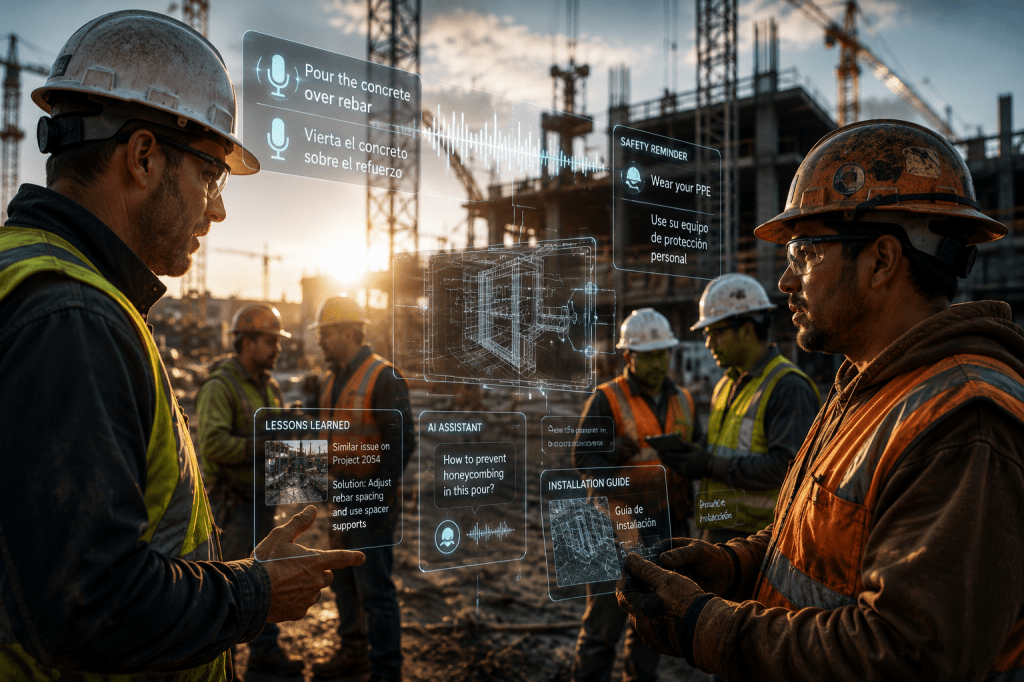
The inability to communicate an idea to someone is a source of significant frustration. Sometimes this is the result of a skill or experience gap. Other times two people just simply don’t speak the same language. Either circumstance is met with the same blank, confused look. On a jobsite, that look can mean an incorrect install, a schedule delay, or a safety hazard waiting to happen. These communication gaps keep us from transferring information vital to project delivery and are more common than the industry would like to recognize. These challenges can be overcome but require intentional effort and planning by the organization.
Technology has transformed the way construction teams communicate. What once seemed like an insurmountable information gap is rapidly being closed by advancements in AI, mobile apps, and cloud-based platforms. We live in an age of exponential advancement and change. Everyday a new solution to an industry problem is created, giving field teams more ways to connect than ever before. A wealth of knowledge and tools is at the fingertips of every person on site. With technology so deeply integrated into our workflows now, why does this communication gap still exist?
Language barriers are a common obstacle in the construction industry. Approximately one-third of the construction workforce is Latino, but construction managers are five times more likely to be non-Hispanic than to be Hispanic (NHCA 2025). This means there is a disproportionately higher chance that the supervisor leading the project will not speak the same language as the crews they are supervising. This gap affects project quality and productivity, but more importantly it compromises site safety. Schedule meetings, toolbox talks, equipment trainings, QA/QC walks, and emergency response all require clear communication between parties.
The go-to solution has been a mobile phone translator app, and these have come a long way since their initial roll-out. Talk-to-text capabilities now make conversations much faster than typing them out. However, the output is only as good as the input so incorrect spelling, slang, and poor pronunciation all affect the outcomes produced. However, rapid advancements in the technology are closing that gap and moving toward instant communication between speakers. Recent progress suggests that real-time, multi-lingual conversations will become increasingly practical on construction sites through the use of a various hardware and software readily available.
Project documents, such as drawings and RFI’s, are the next great hurdle in this frontier. Documents can already be scanned and translated in real time with a phone camera. Platforms like Procore allow for Spanish language settings to make navigation simple for users as well. However, there has not yet been a mainstream integration that automatically converts project documents into the user’s preferred language. A contractor’s ability to interpret drawings in their native language would lead to a significantly higher quality of completed work. With the integration of AI in construction management platforms this feature is likely on the horizon.
Every organization must re-evaluate its SOP’s to determine what communication tools best accomplish its goals and fit into existing workflows. Technology only adds value when it’s implemented consistently by all team members. During onboarding, a standard method of communication should be established for all non-English speaking laborers. This allows each worker to understand exactly when and how to use each tool throughout the project’s duration creating a cohesive working environment that ensures everyone is on the same page. The result is an increase in production speed and quality of work, a reduction of errors and rework, and safe and compliant job site.
Not every communication failure is a result of a language barrier though. Skill gaps are equally severe when left unchecked. The industry and its workforce are in constant flux. Advancements in means and methods, regulation changes, and the retirement of skilled craftsmen all result in pertinent experience and information being inaccessible when needed.
The loss of institutional knowledge from an aging workforce is a direct threat to future project outcomes. Formal education teaches the theory of how work is meant to be performed, but it doesn’t teach what happenes when a situation encountered doesn’t fit the standard. The real-world context is lost and can only be gained through first-hand experience. However, this is where costly mistakes arise. It’s where we have to ask questions to those with more experience, but when they retire or work for a different company who do we ask?
Firms that learn to harness institutional knowledge before it’s lost are the ones that will win. Capturing real data from lessons learned and putting it into a training platform allows firms to turn their project and performance data into actionable intelligence for new hires. By transferring institutional knowledge on day one, a technician can avoid making the same costly mistakes that their coworkers made on previous projects. On the job training is where experience happens, but with a program like this, new hires can go into complex situations more confident than they would have been otherwise. While they may have not encountered something in the real world themselves yet, when they do, they will feel more prepared to take effective action to overcome challenges.
This same data can be fed into a program to create an information bank field teams can draw from as needed. A laborer in the field could ask a question and an AI assistant could provide a response based on how similar issues were handled on previous projects. This creates a single source of truth that keeps hard-won lessons useful to future generations of employees instead of letting them walk out the door when employees leave the company. This allows firms to stop losing money on repeatable mistakes and rework that can easily be avoided through a transfer of knowledge.
AI-powered tools have an additional advantage in their ability to generate images from text-based prompts. Not only can these tools recall and translate important information, but they can also provide a visual reference that explains it in whatever language is required. These applications can create installation guides, annotate drawings, and identify errors. A rendering of a finished product installed in the actual space can be created to easily convey how something should be installed. Real time image generation to demonstrate instructions will change the way we communicate.
Technology alone won’t solve the issues inherent with jobsite communication, but the organizations that build it into their workflows will. As technology continues to evolve what’s being used is less important than how it’s being used. The challenges that face our industry today will be slight inconveniences tomorrow. The speed at which a firm prioritizes addressing them, however, is what will set them apart.
Sources:
National Hispanic Construction Alliance. 2025. State of Hispanics in Construction Report. https://nhca.pro/downloads/2025-NHCA-State-of-Hispanics-in-Construction-Report.pdf


Leave a comment